

Effective and safe project for people
Proyecto efectivo y seguro para las personas

The Las Salinas remediation project is an effective and safe project, which has been designed to remediate the land while taking care of the environment and its inhabitants, and is constantly monitored with first class technology and professionals.

Variables de Monitoreo Ambiental
Aire
La ejecución del proyecto implica emisiones debido a movimiento de suelos, maquinaria, equipos y a la gestión de acopios y biopilas. Para asegurar que las personas y el medioambiente no se verán afectados, hemos tomado múltiples medidas de control.
Estas incluyen la humectación constante de los caminos para reducir la generación de polvo; el uso de maquinaria moderna y eficiente; control de la velocidad de los vehículos en el terreno; y un sistema de succión de aire en las biopilas, el cual utiliza filtros de carbón activado para asegurar que el aire que se libera sea limpio.
Además, hemos instalado una estación de monitoreo de calidad del aire que verificará en todo momento el cumplimiento de las normativas ambientales de la calidad del aire.
Ruido
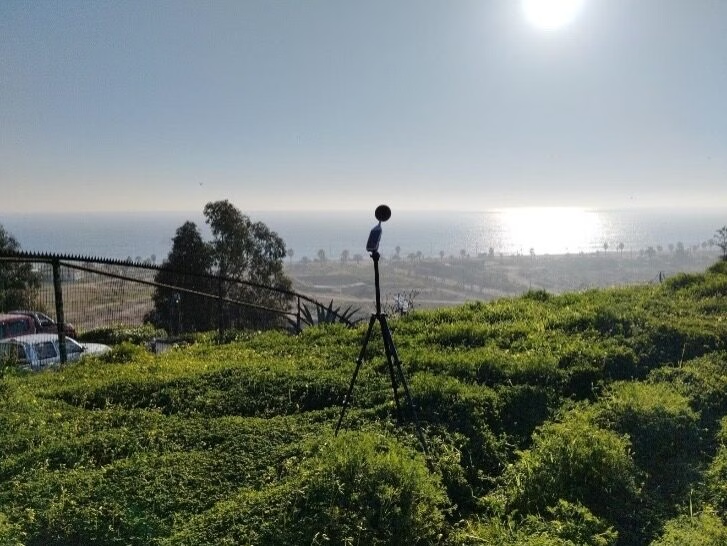
El uso de maquinaria para la instalación de faenas, el movimiento de suelos y la gestión de los acopios podría generar ruidos molestos a nuestros vecinos más cercanos.
Por ello, instalamos pantallas acústicas en las zonas de trabajo para reducir la propagación del sonido; limitamos las actividades simultáneas en áreas sensibles, como controlar el número de máquinas en operación cuando estamos cerca de condominios; y utilizamos maquinaria moderna y silenciosa para reducir el impacto del ruido.
Aguas Subterráneas
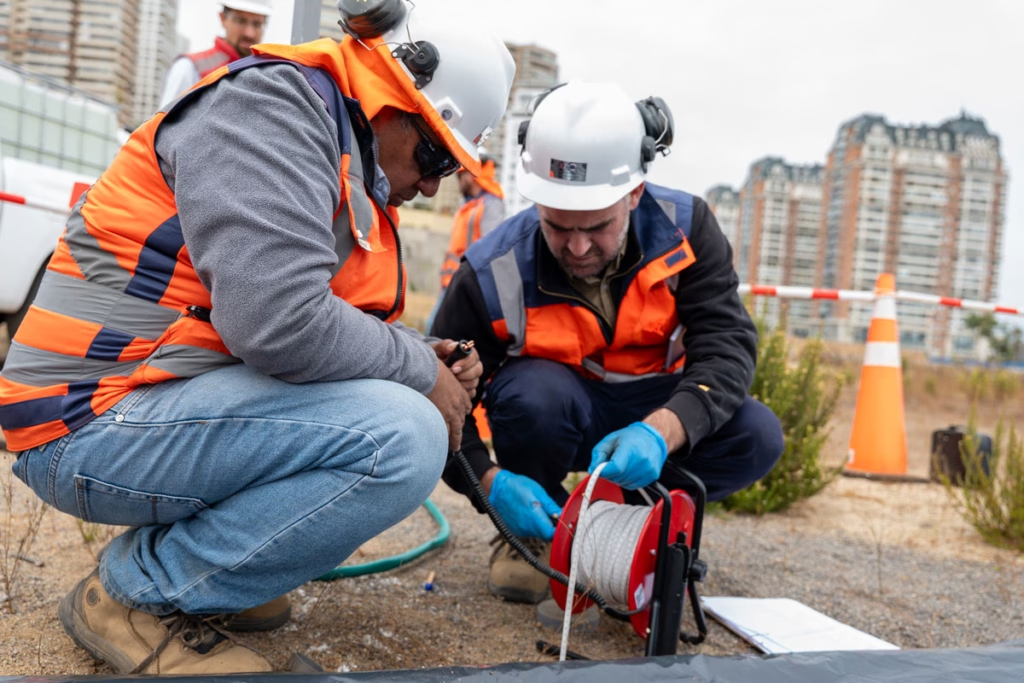
Con el objetivo de remediar el agua subterránea del terreno, se han diseñado dos etapas de tratamiento. Primero un pre tratamiento in situ en el que se incorporan nutrientes directamente en los pozos habilitados en el terreno para proporcionar energía adicional a los microorganismos anaerobios (que no necesitan oxígeno para vivir), y luego un tratamiento durante las excavaciones de suelo, donde se agrega un compuesto especializado de liberación lenta de oxígeno, para reforzar el proceso de biorremediación en microorganismos areobios (que necesitan oxígeno para vivir). Durante el proceso de biorremediación mejorada, monitoreamos las aguas subterráneas para asegurarnos de que el tratamiento esté funcionando de manera efectiva y las aguas se estén limpiando conforme a lo previsto.
Suelo
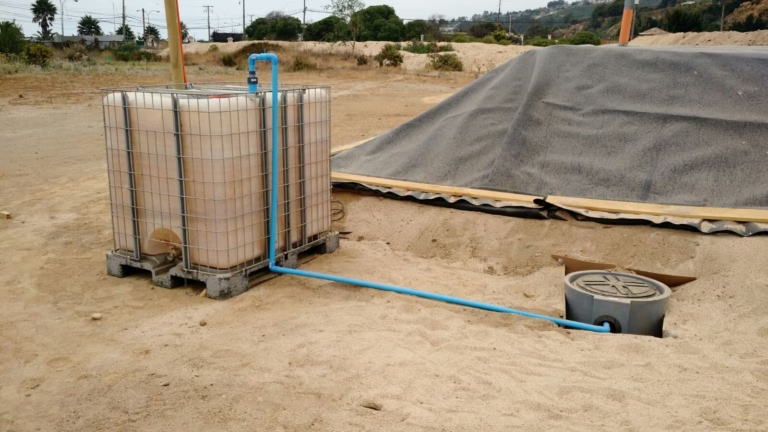
La biorremediación se hace implementando Biopilas que son montículos de arena, que se cierran y controlan componentes claves como temperatura, aire y nutrientes. Estas biopilas están diseñadas para evitar cualquier fuga de contaminantes hacia el entorno. A medida que los microrganismos se alimentan de los hidrocarburos presentes en el suelo es esencial monitorear la calidad de éste para asegurar que los niveles de contaminantes disminuyan de acuerdo con los objetivos del proyecto. En cada biopila se establecen puntos de muestreo donde, de forma mensual, se toman muestras para evaluar el progreso en la reducción de los contaminantes. Y, luego de culminado el proceso de cada biopila se procede a la toma de muestras de gas en el suelo para verificar la eficiencia de todo el proceso de remediación.
Olores
Hemos implementado medidas de control para evitar la emisión de olores molestos, como excavaciones en secciones acotadas, humectación y aspersores en frentes de trabajo, además de la cobertura y monitoreo de las biopilas.
De manera preventiva y complementaria, hemos implementado un completo y robusto sistema de detección de olores que si bien no es un requisito de la RCA, ayudará a brindar mayor tranquilidad a la comunidad, el que consta de 2 pilares fundamentales:
- Monitoreo de olores en terreno, que constituye una línea base con un equipo de personas en terreno seleccionado y calibrado según la norma chilena.
- Monitoreo en línea, con sensores físicos instalados en el perímetro del terreno, que miden en tiempo real partes por millón de compuestos orgánicos volátiles.

How are we doing this follow-up for people?
Las Salinas has an air quality monitoring station installed on the site and operated by an Environmental Technical Control Entity (ETFA) certified by the Ministry of the Environment. This station permanently provides us with crucial data to safeguard air quality in Las Salinas and the surrounding area, protecting people’s health.
Air quality monitoring stations serve to measure air quality accurately and up to date in a given geographical area.
The Las Salinas monitoring station is operated by an Environmental Technical Control Entity (ETFA), which directly provides information to the environmental authority.
The data generated are used to evaluate compliance with environmental standards and regulations and to take corrective actions, if necessary.
Environmental variables
for monitoring
The air quality monitoring station is operated by an Environmental Technical Control Entity (ETFA), certified by the Ministry of the Environment, and provides us with crucial data that allows us to safeguard air quality in Las Salinas and the surrounding area.
The data presented are collected directly from the installed devices and are automatically processed on a daily basis. Due to this, and considering the characteristics of the devices and the conditions of the environment, these data will be verified in case of possible failures or incidents.
Select the variable you want to check:
Maximum air quality emission standard
Moving Annual Average Las Salinas Monitoring Station
Download
monitoring reports2024
Informes 2024
To keep our community informed, we publish the results of air quality monitoring conducted at our station directly in this section. The data are available within the first 10 working days of the month following receipt of the corresponding report.

Latest in Bioremediation
Check out the most recent activities we have carried out as part of our sanitation work in Viña del Mar.




5 Frequently Asked Questions about Bioremediation
Why should it be remediated only in the deeper layers?
A: The oil companies that had stopped operating in Las Salinas submitted a first EIA called “Recuperación Terreno Las Salinas” on December 20, 2002, which obtained an Environmental Qualification Resolution (RCA) that was favorably qualified by the Regional Environmental Commission (COREMA) of Valparaíso (or regional CONAMA), through Exempt Resolution No. 203 of October 7, 2004.
The first stage of remediation of the Las Salinas site was carried out between 2009 and 2013, during which time 47 thousand tons of contaminated soil were removed and the surface and subsoil facilities of the fuel distribution companies that operated until 2000 were dismantled. This explains why the first meter of soil on the site has been completely remediated.
After the first phase of remediation, studies established that the major contamination of the soil is associated with hydrocarbon compounds, which are located between 5 and 8 meters deep.
Is it dangerous for bacteria to be so close to populations?
A: Bacteria are everywhere on a massive scale, in gardens, in parks, in our refrigerator, etc. So far, after more than 70 years of a naturally activated process, there is no record of them being a threat to populations, because they are bacteria adapted to surplus and remaining hydrocarbons, and not to human pathologies.
How do bacteria travel and can they reach our homes?
A: It is impossible for bacteria to travel to the surrounding dwellings or beyond, let alone in a non-homogeneous environment.
The movement of bacteria is on a microscopic scale, imperceptible to human measurement standards; their world (cosmos) is reduced to a dimension not perceptible to man. Moreover, bacteria cannot fly.
Why is phytoremediation not applied at the site?
A: Because there is no pre-existence in the place that we can take as a reference, the ruderal (colonizing species in uninhabited or abandoned sites) present do not do phytoextraction, fundamentally because the contaminants are below 6 to 7 meters in the subsoil, even if we bring them to the surface to force phytoremediation the species to be incorporated will change the matrix of the contaminants, that is to say, the contaminants are extracted by the plants that later would have to be eliminated in another way. In addition, there is no possibility of tree species for coastal soils where the substrate is mineral (sands), with brackish soils. Clearly a technique that does not apply to this type of site and soil type.
Why do they install the monitoring stations inside the field and not in the surroundings where people live?
A: Because the source of contamination to be monitored is the site itself, it is the closest location to a potential exposure and, therefore, where measurements will be highest. Monitoring within the contaminated site and not in the surrounding area helps to differentiate the contaminants coming from the site in question and not from other sources, such as local industry or traffic, and allows to evaluate the effectiveness of corrective measures in real time.